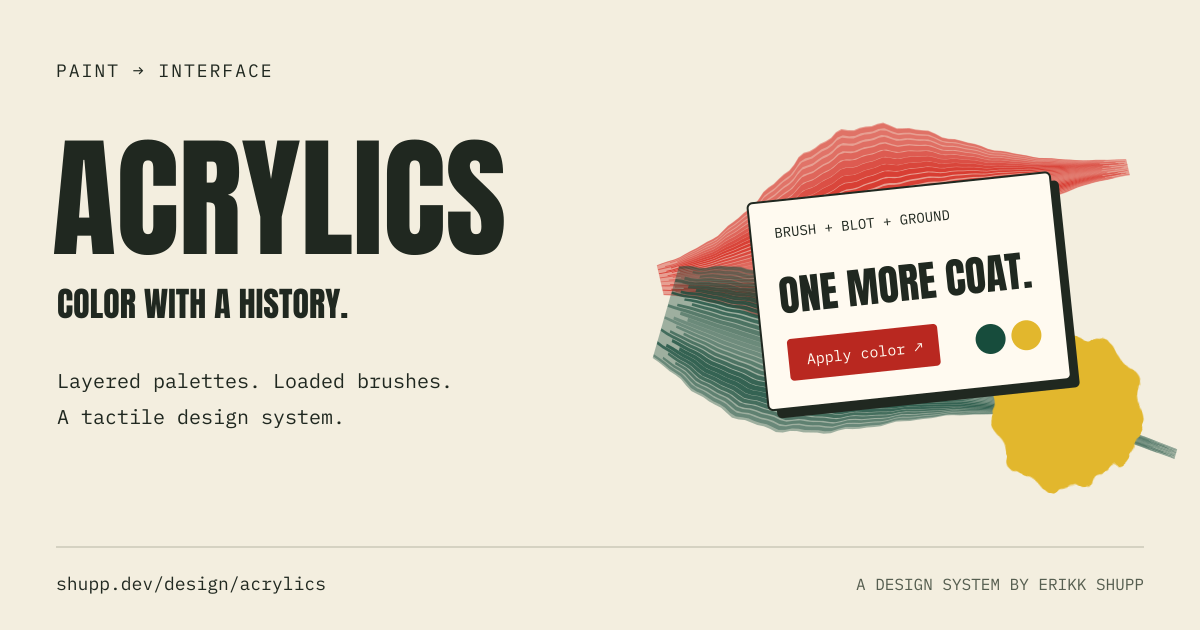
Acrylics: a paint-mixing design system for the web
How Acrylics turns layered color, pigment-inspired math, expressive shapes, and tactile early-web controls into a usable interface system.
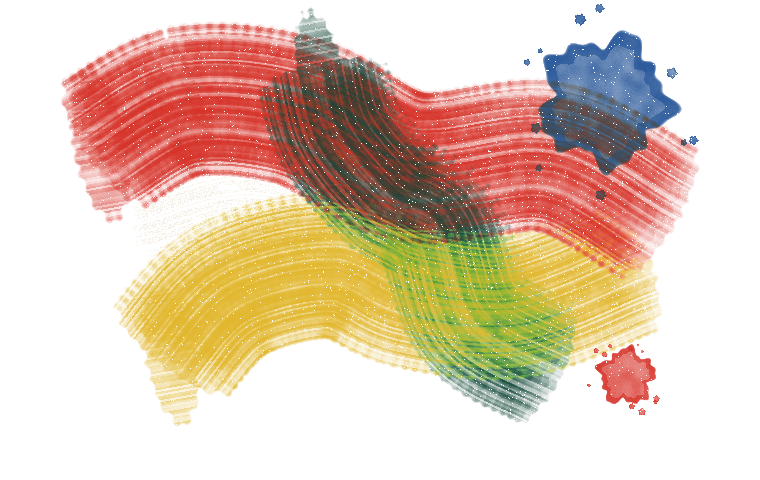
Acrylics documents a visual language built from tall market-sign typography, loaded brushstrokes, pooled blots, and tactile early-web controls. The page demonstrates the language while explaining how to build with it.
Three schemes—Market, Cobalt, and After hours—recolor the whole reference page. Semantic tokens separate ground, surface, ink, action, and supporting pigments. Raw pigments can mix into muted colors; action and text colors use explicit, contrast-checked pairs.
The component reference covers actions, selection, fields, validation, feedback, disclosures, surfaces, and dialogs. Five reusable Astro primitives form the core: Button, ChoiceChip, PaintMark, SurfaceCard, and Dialog. Typography, geometry, spacing, motion, and usage rules explain how the parts work together. Copy the current scheme’s CSS or download the token definitions and stylesheet.
The material workshop keeps the paint studio and geometry experiments as an optional deeper reference. Spectral.js (MIT) provides pigment-inspired mixing; digital overlays use sRGB compositing. Neither model predicts a particular brand of physical paint.
Interactive examples stay in page memory and reset on reload. The reference page is isolated from the site’s existing homepage and visual themes.